The LEARN System
A physically embodied autonomous scientific observation system
The Core Cycle
Observe → Record → Analyze → Experiment → Learn
Observe
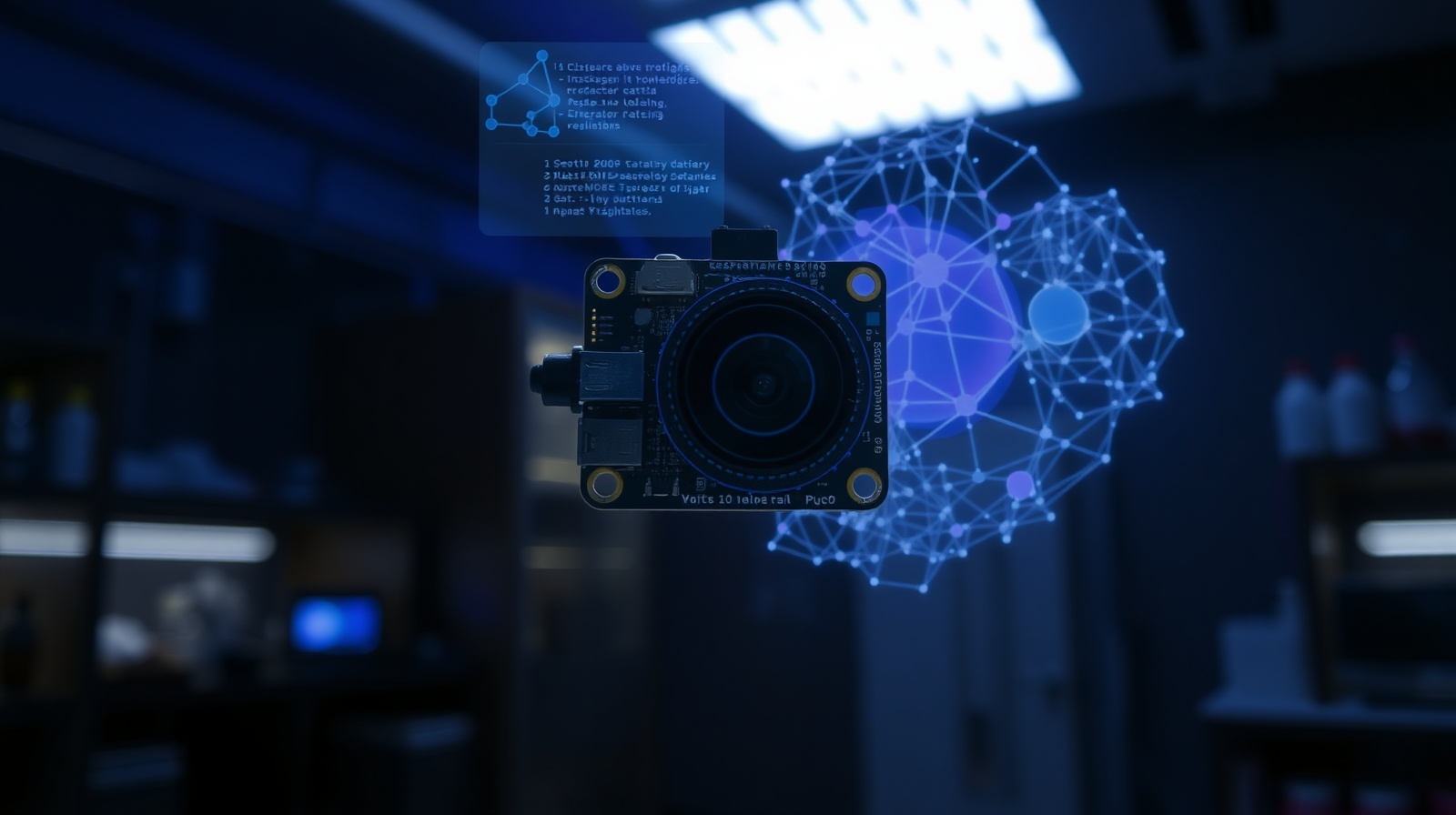
Raspberry Pi cameras continuously monitor the laboratory environment, capturing visual and environmental data streams in real-time.
Record
All observations are automatically logged into the autonomous research notebook with precise timestamps and contextual metadata.
Analyze
Interpretive models process the sensory data, measuring the residual approximation between predicted states and actual observations.
Experiment
The system identifies gaps in understanding and proposes controlled experiments to reduce uncertainty and refine models.
Learn
Knowledge accumulates through iterative cycles, with the system evolving its understanding of the physical environment.
System Architecture
Four integrated layers working in harmony
Sensory Layer
Raspberry Pi camera modules and environmental sensors provide continuous physical observation.
Memory Layer
Time-series database stores all observations, creating a persistent record of the laboratory ecosystem.
Interpretive Layer
Machine learning models analyze patterns, predict states, and measure residual approximation errors.
Integration Layer
Connects human intuition with machine precision, creating a unified field of distributed intelligence.
Key Principles
The foundational ideas guiding LEARN's design
Embodied Intelligence
Intelligence emerges from the interaction between mind, body, and environment. LEARN is physically present in the laboratory, not just a software abstraction.
Residual Approximation
The system measures the gap between its predictive models and actual observations, using this error signal to drive learning and refinement.
Distributed Cognition
Knowledge is distributed across human researchers, AI systems, and physical sensors, creating a unified field of collaborative intelligence.
Discrete Cognitive Segmentation Events
Temporal markers of state transitions in the learning cycle
The core cycle operates not just through residual reduction but through discrete cognitive segmentation events — measurable, automatic transition points where the system moves between processing states. These events mark natural boundaries in the Observe → Record → Analyze → Experiment → Learn sequence.
Observation-to-Representation Transition
A segmentation event marks the boundary where raw sensory data transitions into structured representation. The system automatically commits to a model state based on accumulated observations.
Hypothesis-Generation Commit
After analysis, a segmentation event signals the commitment to a specific hypothesis or prediction. This marks the boundary between uncertainty exploration and focused prediction.
Validation-to-Adaptation Consolidation
A consolidation event marks where experimental results are integrated into updated models. Working-memory representations become long-term structural knowledge.
These events are load-dependent: they occur with different timing depending on information-processing demand. During high uncertainty, segmentation events may be frequent; during stable states, they occur less often. The structure of these events provides a real-time signature of the system's cognitive state.
What Makes LEARN Different
Traditional Lab Notebooks
- • Manual observation and recording
- • Subject to human memory and bias
- • Disconnected from real-time data
- • Static, historical records
- • Individual researcher perspective
LEARN System
- • Continuous autonomous observation
- • Objective, sensor-based recording
- • Real-time integration with environment
- • Dynamic, evolving knowledge base
- • Distributed intelligence perspective
Explore Further
Discover how LEARN is being implemented and the research driving its development.