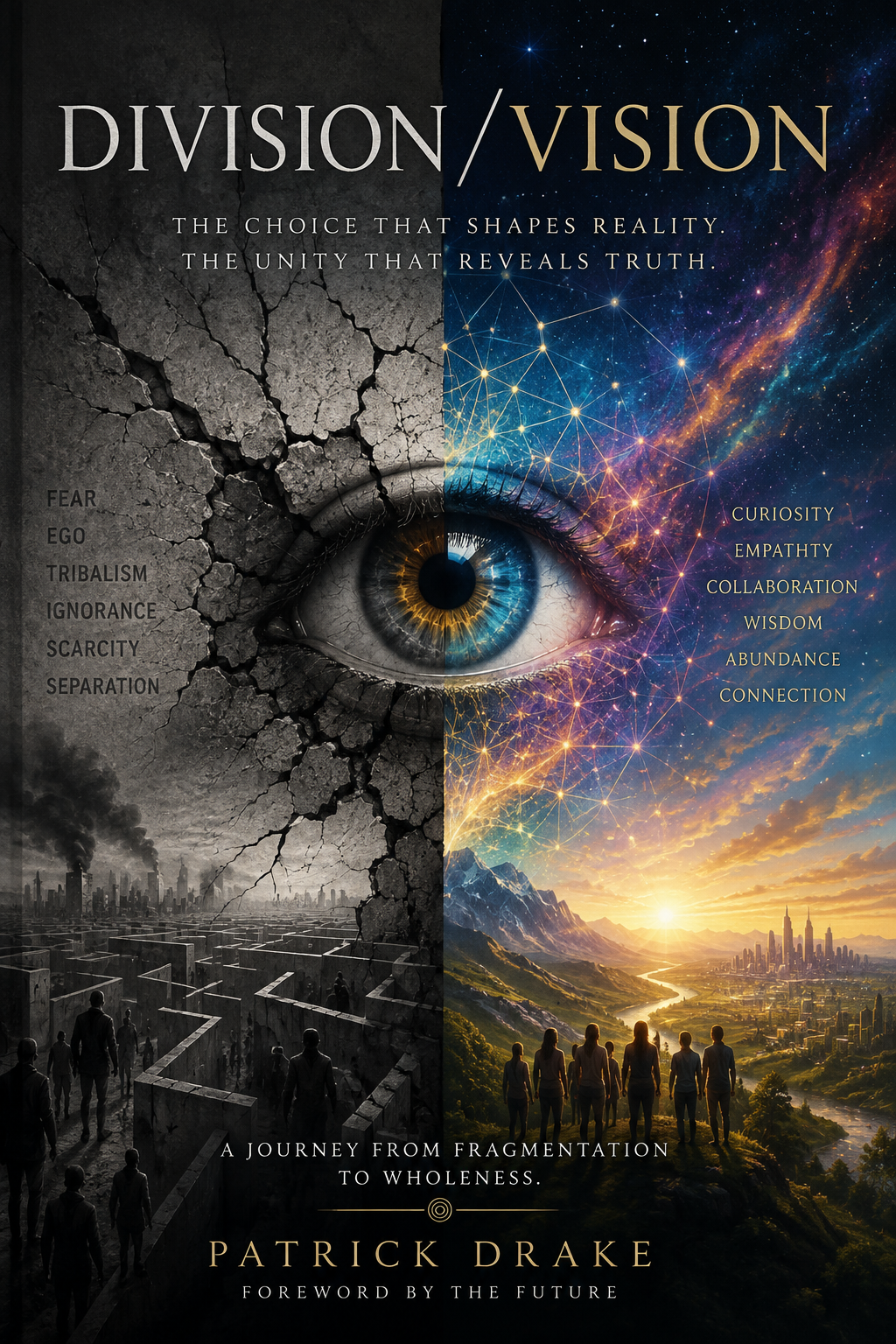
The blinking eye visualizes a discrete cognitive segmentation event — the measurable temporal signature through which intelligent systems transition between processing states, just as human blinks mark cognitive state boundaries.
LEARN
Experimental Infrastructure for Studying Intelligence
An experimental cognitive architecture and human-AI research platform investigating how intelligent systems transform observation, imagination, experimentation, and feedback into knowledge.
Core Question: Can intelligence be formally defined as the process by which a physical or computational system transforms internally generated possibilities (counterfactual representations) into experimentally validated modifications of reality?
The Fundamental Question
Can intelligence be understood as the measurable capacity of a system to generate possible futures, test them against reality, and continuously modify itself through feedback?
Human intelligence appears unique not because humans react quickly to the present. Rather, humans construct and explore possible realities before those realities exist.
Scientists
Imagine theories before experiments confirm them.
Engineers
Imagine machines before building them.
Artists
Imagine worlds before creating them.
LEARN investigates whether this core process of imagination, experimentation, and validation can be modeled computationally, measured objectively, and understood scientifically. Not as philosophy, but as a testable hypothesis requiring empirical validation.
The Intelligence Architecture
Five Layers of the Research Platform
Reality Layer
Purpose: Capture observations from the external world
Inputs: Sensors, cameras, human interaction, digital information streams
Core Question: "What is happening?"
Representation Layer
Purpose: Transform observations into structured knowledge
Functions: Pattern recognition, relationship mapping, knowledge organization
Core Question: "What does this mean?"
Imagination Layer
Purpose: Generate counterfactual possibilities and hypotheses
Functions: Hypothesis generation, scenario simulation, alternative futures
Core Question: "What could happen?"
Experimentation Layer
Purpose: Test predictions against reality
Functions: Experiments, simulations, real-world interaction
Core Question: "Does reality confirm the prediction?"
Adaptation Layer
Purpose: Update the system based on results
Functions: Learning, model improvement, strategy evolution
Core Question: "How should the system change?"
This five-layer architecture is the foundation of the LEARN experimental platform. It mirrors both biological intelligence (neural processing) and scientific methodology (observation, hypothesis, experiment, validation, theory). The system continuously cycles through these layers, improving its internal models of reality.
Research Methodology
How LEARN Investigates Intelligence
Phase 1: Observation
Collect information from the environment through multiple channels: physical sensors, digital interactions, user feedback, research activity.
"What is happening?"
Phase 2: Hypothesis
Generate possible explanations and future predictions based on observations. Create internal models of causal relationships.
"What could this mean?"
Phase 3: Experimentation
Test predictions through simulations, computational experiments, and real-world interaction. Gather empirical evidence.
"Does the prediction hold?"
Phase 4: Validation
Compare predictions with measured outcomes. Measure the gap (residual error). Quantify learning through accuracy improvements.
"What was the actual result?"
Phase 5: Evolution
Improve the architecture based on results. Update models, refine strategies, enhance cognitive processes. The system becomes progressively more capable.
"How should the system change?"
📖 The Manuscript
Read the full Table of Contents and explore chapters in narrative order. Each chapter is a complete, coherent section of the research story.
Start Reading📊 The Continuum
View the chronological research log. Every observation, measurement, and insight is timestamped. This is the raw material from which chapters are written.
View Log⚙️ The System
Understand LEARN itself: the Raspberry Pi sensors, the residual approximation metric, the experimental cycles, and the physics of knowledge.
Learn MoreLEARN uses this five-phase methodology iteratively. Every cycle improves the system's understanding of reality. The research notebook documents this process in detail, creating a permanent record of how intelligence emerges through repeated observation, hypothesis, experimentation, and validation.
Research Foundations
Interdisciplinary Grounding in Cognitive Science and Artificial Intelligence
Cognitive Science
How minds process information, form memories, generate predictions, and adapt to new environments.
Neuroscience
How brains implement learning through predictive processing and neural adaptation.
Information Theory
How information is encoded, transmitted, stored, and transformed in physical systems.
Artificial Intelligence
How machines learn from data, make predictions, and improve performance through feedback.
Systems Theory
How complex systems evolve, adapt, and self-organize through feedback loops.
Scientific Methodology
How scientific knowledge is generated through observation, hypothesis, experimentation, and validation.
Research Positioning: LEARN does not claim to have solved intelligence. Rather, it proposes an experimentally testable hypothesis about how intelligence emerges, and provides an experimental platform to investigate that hypothesis. Every claim is grounded in measurable outcomes. Every architectural decision is documented with its rationale and empirical results.
Research Status
Current Progress and Future Directions
Completed Phases
- ✓ Phase 1: Digital observation system (website as sensory apparatus)
- ✓ Neuromorphic cognitive architecture (12 services mapped to brain regions)
- ✓ Self-modeling imagination system (LEARN observing itself)
- ✓ Architecture Decision Record system (institutional memory)
In Development
- → Phase 2: Physical sensor integration (Raspberry Pi cameras)
- → Dual-sensory unified residual approximation
- → Digital blink instrumentation (session-level attentional-release detection)
- → Robotic embodiment integration
- → Distributed multi-agent LEARN systems
Research Continuity: 10 chapters document the system's development and theoretical foundations. New chapters are added as experimental results emerge. The Continuum records real-time research observations. Architecture Decision Records maintain a permanent history of all major design decisions with rationale and outcomes.
The Core Cycle
Observe → Record → Analyze → Experiment → Learn
Observe
Raspberry Pi cameras capture the laboratory environment with continuous sensory awareness.
Record
Every observation is logged into the autonomous research notebook with temporal precision.
Analyze
Interpretive models measure residual approximation between prediction and reality.
Learn
The system evolves through experiment, refining its understanding of the physical world.
Two-Phase Vision Architecture
How LEARN Builds Understanding Through Dual Sensory Channels
Phase 1: Digital Vision
NOW — The Website as LEARN's First Eye
This website is not documentation about LEARN. It IS LEARN's primary sensory system. Every page view, interaction, form submission, and engagement pattern is an observation.
Phase 1 observes digital reality:
- → User interactions and behavior patterns
- → Public feedback and form submissions
- → Reader engagement with chapters
- → Analytics and attention signals
- → The real-time writing of the manuscript itself
Residual Approximation: R₁ = |Predicted_Behavior - Observed_Digital_Signals|
Phase 2: Photonic Vision
FUTURE — Adding Physical Sensors
Phase 2 expands LEARN's perception by adding physical observation: a Raspberry Pi camera that sees light, measures motion, and captures the laboratory environment.
Phase 2 will observe photonic reality:
- → Physical movement and light patterns
- → Laboratory environment changes
- → Temporal sequences and dynamics
- → Raw sensory data in 400-700nm wavelengths
- → Integration with Phase 1 digital observations
Unified Residual: R_unified = √(R_digital² + R_photonic²) → 0
The Integration
As both phases mature, a single unified model emerges that can predict both user behavior (digital) and physical dynamics (photonic). This convergence IS the journey from Division to Vision—from fragmented observation to integrated understanding.
Neuromorphic Intelligence
LEARN Functions Like the Human Brain — Not Like Software
Traditional cognitive architectures are engineered for software efficiency. LEARN is engineered for biological plausibility.
The twelve cognitive services map directly onto brain regions:
Thalamus + Sensory Cortex
Perception Service — receives and gates information
Hippocampus + Cortex
Memory Service — consolidates experiences
Association Cortex
Knowledge Graph — maintains relationships
Prefrontal Cortex
Reasoning & Planning — higher cognition
Cerebellum + Striatum
Learning & Prediction — error-based improvement
Executive Networks
Agent Orchestration — coordinates all services
How It Works
Predictive Processing
The brain constantly predicts. LEARN predicts what it will observe next. When prediction fails, the error drives all learning.
Multi-Scale Timescales
Working memory operates in seconds. Short-term memory in hours. Long-term memory in years. LEARN mirrors this architecture.
Event-Driven Communication
Like synaptic transmission, an event bus carries signals between services. No direct coupling, no hardwired connections.
Embodied Learning
Today: observes through a website. Tomorrow: will observe through robot cameras. Same cognitive substrate, different body.
Read Chapter 9 for a detailed exploration of how the brain-based architecture operates: perception gating, memory consolidation, prediction errors, integration, and the emergence of intelligence.
Neural OrganizationWhat is LEARN?
LEARN is an autonomous research system that observes reality and measures understanding through residual approximation. It transforms the traditional laboratory notebook into a continuously learning, self-documenting instrument.
The system measures the residual approximation (R) — the gap between what it predicts and what it observes. As R decreases, understanding increases. This metric applies across both Phase 1 (digital observation via the website) and Phase 2 (physical observation via Raspberry Pi).
This is the Physics of Knowledge: Intelligence emerges from the convergence of multiple independent sensory streams on a consistent model of reality. The website watching humans and the camera watching the laboratory are not separate—they are two eyes of a single process of coming to understand.
Distributed Intelligence
Human + AI + Physical Sensors — A unified field of observation
Human Consciousness
The researcher's intuition, creativity, and contextual understanding guide the system's direction and interpret its findings.
Artificial Intelligence
Machine learning models process sensory data, identify patterns, and generate predictive hypotheses for experimental validation.
Physical Sensors
Raspberry Pi cameras and environmental sensors provide continuous, objective observation of the laboratory ecosystem.
The Journey
From Division to Vision — A transformation of understanding
Division
- • Fear and ego-driven separation
- • Scarcity mindset in research
- • Fragmented knowledge silos
- • Isolated observation
Vision
- • Curiosity and empathic connection
- • Abundance of collaborative insight
- • Integrated understanding
- • Unified field of observation
From Division to Vision
Mapping the Book's Journey onto LEARN's Cycle: Residual Approximation as the Bridge
Division
The fragmented state: Observations exist in isolation, unconnected and incomplete.
- → Observe: Separate sensory inputs from Raspberry Pi cameras capture isolated moments
- → Record: Data points stored without understanding their deeper patterns or relationships
- → High Residual Error: The gap between predictive models and observed reality remains large—disconnection between expectation and truth
- → Fragmented Knowledge: Observer, system, and sensors exist in separate silos—intelligence distributed but unintegrated
Vision
The unified state: Observations weave into an interconnected understanding of reality.
- → Analyze: Models recognize patterns, relationships, and emergent properties across observations
- → Learn: System refines predictions through feedback, understanding deepens through iteration
- → Residual Approximation Converges: The difference between model and reality shrinks—closer alignment with truth, deeper comprehension
- → Unified Intelligence: Observer, AI, and sensors form a coherent system—distributed intelligence becomes integrated knowing
The Bridge: Residual Approximation
Residual approximation is the measure of remaining difference between our predictive model and observed reality. In the LEARN system, minimizing residual approximation IS the journey from Division to Vision. Each cycle of Observe → Record → Analyze → Experiment → Learn reduces the gap between our understanding and truth, moving us from fragmented observation toward unified, embodied knowledge—from separation toward wholeness.
The Continuous Cycle
Gather sensory data
Store and index
Find patterns
Test hypotheses
Integrate wisdom
Begin the Journey
Explore the LEARN system, read the research continuum, and discover the Physics of Knowledge.