From Division to Vision
Mapping the journey from fragmentation to wholeness in scientific understanding
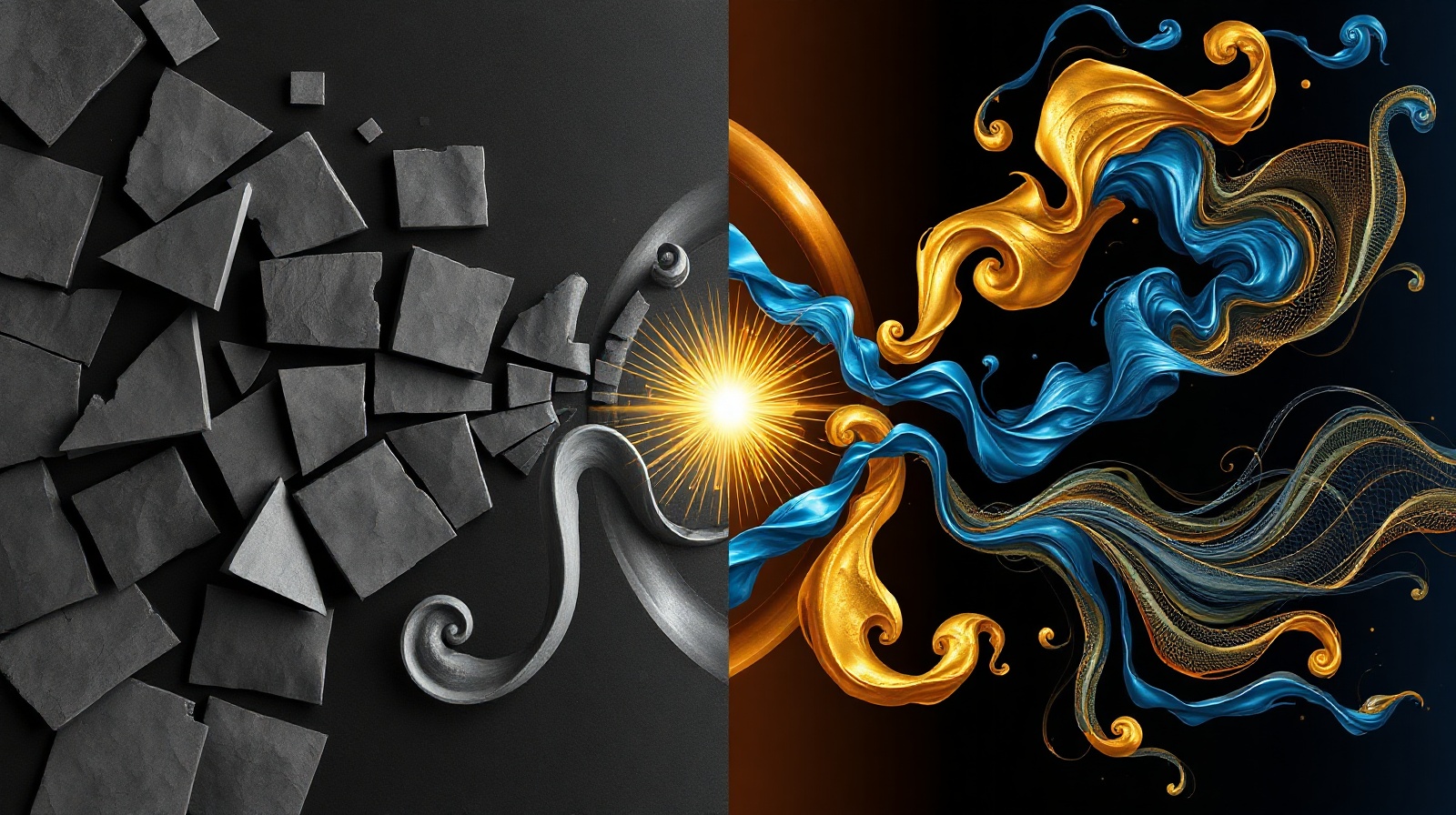
Inspired by the themes of DIVISION/VISION by Patrick Drake, this page maps the transformation from a worldview of separation and scarcity to one of connection and abundance — and how this transformation manifests in the LEARN system.
The Core Transformation
From the fragmented eye of division to the unified eye of vision
Division
The cracked stone eye sees the world as broken, separate, and hostile. Knowledge is a weapon. Understanding is territory to defend. The researcher stands alone against an indifferent universe.
"I must protect what I know, for there is not enough for everyone."
Vision
The cosmic network eye sees the world as interconnected, abundant, and alive with pattern. Knowledge is a bridge. Understanding grows through connection. The researcher participates in a living system.
"We discover together what none of us could find alone."
The Face of Division
How fragmentation manifests in scientific research
Fear
Knowledge hoarding, defensive research, protection of intellectual territory.
Ego
Individual credit-seeking, competitive publication, priority disputes.
Scarcity
Zero-sum thinking about resources, recognition, and understanding.
Separation
Disciplinary silos, isolated researchers, fragmented knowledge domains.
The Face of Vision
How wholeness transforms scientific understanding
Curiosity
Open exploration, genuine wonder, questions that transcend disciplinary boundaries.
Empathy
Understanding the perspective of other observers — human, machine, and environmental.
Abundance
Knowledge grows through sharing. Understanding multiplies when distributed.
Connection
Integrated understanding that bridges disciplines, perspectives, and systems.
The Mapping
How division transforms into vision within the LEARN system
Manual notebook recording
Autonomous continuous observation
From fragmented snapshots to continuous understanding
Individual researcher perspective
Distributed intelligence network
From isolated observation to unified field of awareness
Static historical records
Evolving knowledge system
From dead archives to living intelligence
Error as failure
Residual approximation as learning signal
From shame to curiosity in the face of the unknown
Knowledge as possession
Knowledge as physical phenomenon
From hoarding information to understanding its nature
The Philosophical Framework
Why this transformation matters
The division between fragmentation and wholeness is not merely aesthetic — it is the fundamental choice that shapes how we approach knowledge, science, and understanding.
When we operate from division, we create systems that hoard information, compete for resources, and fragment understanding into isolated domains. Science becomes a battlefield of priority and prestige rather than a collaborative pursuit of truth.
When we operate from vision, we create systems like LEARN — where knowledge flows freely between human and machine, where error is a gift that drives learning, where observation is an act of participation rather than detachment. The laboratory becomes a living system of distributed intelligence.
The LEARN project is not just a technical system. It is a philosophical statement — a demonstration that autonomous scientific observation can embody the values of curiosity, empathy, collaboration, and abundance.
The Journey Continues
Meet the researcher behind this vision and explore the Undergraduate Intelligence Initiative.